
Overview
Chennai, formerly known as Madras, was the capital of the Southern British India. Many great monuments were built during the British rule and several of them continue to dominate the skyline of Chennai even today. In this walking tour, we will visit some of the prominent landmarks of Chennai, which were built during the British era in an architectural style blending British as well as Indian elements.
We will start at the Central Railway Station and walk to Ripon Building, Southern Railway Headquarters, Victory Memorial, Fort St George, Naper Bridge and finish at Madras University building.
- Recommended by 98% of travelers
- Badge of Excellence
- Free cancellation up to 24 hours before
- Mobile ticket
What's included
Tea and coffee
Local guide
All taxes, fees and handling charges
Hotel pickup and drop-off (if option not selected)
Meeting and pickup
Pickup is offered, or you can meet at the meeting point.
Meeting point
Meet our guide at the main entrance of Egmore Railway Station
What to expect
-
20 min
The Egmore railway station is more than a 100 years old and one of the earliest buildings built in Indo-Saracenic styke. Designed by the legendary Henry Irwin to be larger than Charring Cross station of London, the Station was built by Samynatha Pillai. The building is a fine blend of Gothic and Dravidian design styles. It is the ideal place to start our walk about British Architecture in Chennai.
-
Chennai Central Railway Station
30 min
The Central Railway Station was built in 1873 in Gothic Revival style by British architect George Harding. It was modified by Robert Chisholm who added the central clock tower and Travancore caps on the main towers. Today, this station handles more than 350000 passengers every day.
-
20 min
Victoria Public Hall was opened to the public in 1887 to commemorate the Golden Jubilee of Queen Victoria. The hall, named after the queen herself, had been a venue for various events like public meetings, and even film screenings. The hall was designed by British architect Robert Chisholm and it is an excellent example of Indo-Saracenic architecture. Namberumal Chetty, who had by then constructed various public structures in the city of Madras, built the structure.
-
15 min
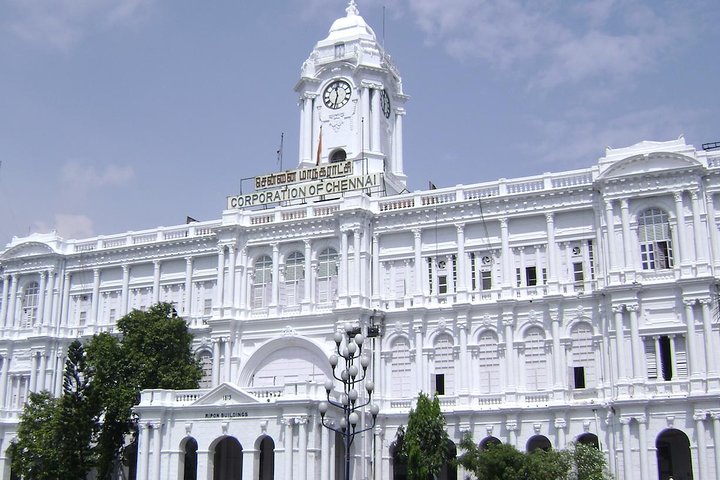
British Architecture Walk continues to Ripon Building which was commissioned in 1913. Designed by G.S.T. Harris. and built by Loganatha Mudaliar, the Ripon building is named after Lord Ripon, a Governor-General of British India who was famously known as the father of local self-government in Chennai. Today this building is the office of Mayor of Chennai.
-
15 min
We next walk to the headquarters of Southern Railways in India. Built in Indo–Saracenic style, this building was designed by N. Grayson and built by Samynada Pillai. It was completed in the year 1921. The Southern Railway headquarters was one of the earliest buildings in India to be built with reinforced concrete.
-
Napier Bridge
15 min
Napier Bridge was built in 1869 across the Coovum river and is named after the British governor of Fort St George, Francis Napier. It connects the Marina to the Fort St George. The narrow bridge was broadened and converted into a concrete structure and was opened to general public in July 1943. This bridge is often used by Media to represent the city of Chennai!
-
University of Madras
15 min
The Senate House is the administrative center of the University of Madras. It is situated along the Marina Beach. Constructed by Robert Chisholm , the Senate building is considered a great example of the Indo-Saracenic style with a harmonious blend of Byzantine architectural features. This masterpiece was constructed between April 1874 and 1879. It has a convocation hall, porticos, a parapet, meeting halls and a library.
-
Victory War Memorial
15 min
The Victory War Memorial, formerly called the Cupid’s bow, is a memorial constructed to commemorate the victory of the Allied Armies during World War I (1914–1918). It later became the victory war memorial for World War II (1939–1945), erected in the memory of those from the Madras presidency who lost their lives in the wars.
Cancellation Policy
For a full refund, cancel at least 24 hours before the start time.
Times are local to the experience (Asia/Kolkata).
Additional Information
- Suitable for all physical fitness levels
- Mobile or paper ticket accepted
- Up to 15 travelers per booking
- Each booking must include at least one adult.
FAQs about British Architecture Walk in Chennai
Can I cancel British Architecture Walk in Chennai for free?
Yes. For a full refund, cancel at least 24 hours before the start time.
How long does it take?
It takes about 2 hours 30 min.
Where does it start, and is pickup offered?
Meet our guide at the main entrance of Egmore Railway Station Pickup is offered, or you can meet at the meeting point.
What's included?
- Tea and coffee
- Local guide
- All taxes, fees and handling charges
What's not included?
- Hotel pickup and drop-off (if option not selected)
Which places does it visit?
It visits Chennai Central Railway Station, Napier Bridge, University of Madras, Victory War Memorial.
Which languages is it offered in?
It is offered in English.
What fitness level is needed?
It is suitable for all physical fitness levels.
Is it suitable for children?
Children must be accompanied by an adult.
Operated by 5 Senses Walks